
As the world’s population races toward 10 billion, the question of how to keep everyone fed looms larger than ever. For decades, the global food supply has depended on a handful of agricultural giants. But a quiet transformation is underway—one that could see Africa not just feeding itself, but nourishing the entire planet.
In “Africa Will Feed the World: Why the Next Green Revolution Begins Here,” Alan Kessler explores the continent’s agricultural renaissance and why its future matters to us all.

Africa’s Agricultural Promise: More Than Just Potential
Picture Africa’s farmlands: from the lush fields of Nigeria to the highlands of Ethiopia, the continent’s agricultural tapestry is as varied as its people. Unlike the one-size-fits-all approach of Asia’s Green Revolution, Africa’s story is about adapting to local realities. Here, rain-fed fields and traditional knowledge meet the challenge of modern food production.
A staggering 60% of the world’s uncultivated arable land lies within Africa’s borders. This isn’t just a statistic—it’s a call to action. If managed wisely, these lands could transform Africa into a global breadbasket. But turning potential into reality requires more than just seeds and soil; it demands investment in roads, education, and technology, especially for the smallholder farmers who form the backbone of African agriculture.
Smallholder Farmers: Cultivating Change from the Ground Up
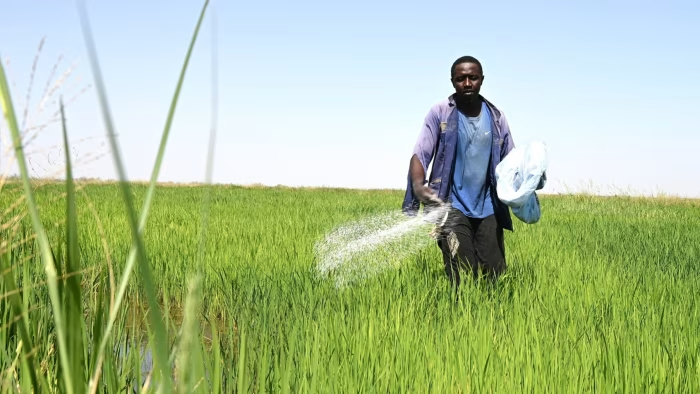
Walk through any rural village, and you’ll see the heart of Africa’s food system: smallholder farmers. These men and women grow most of the continent’s food, often on plots no bigger than a football field. Empowering them isn’t just the right thing to do—it’s the smart thing.
Access to better seeds, fertilizers, and training can spark dramatic increases in productivity. Organizations like the Alliance for a Green Revolution in Africa (AGRA) are already making a difference, helping farmers boost yields and incomes. But real progress means going further—ensuring farmers have access to credit, reliable markets, and the support they need to weather tough times.
Technology and Innovation: Africa’s Leap Forward
Africa’s farmers are embracing a new era of agricultural innovation. Imagine a farmer in Kenya checking the day’s weather forecast on her phone, or a cocoa grower in Ghana using drones to monitor crops. These aren’t scenes from the future—they’re happening now.
Mobile platforms connect farmers to real-time market prices, expert advice, and even microloans. Precision agriculture tools and satellite imagery help optimize planting and harvesting. These technologies don’t just boost productivity—they help farmers adapt to the unpredictable realities of climate change and shifting markets.
Farming for the Future: Sustainability and Resilience
Climate change is rewriting the rules of agriculture, and Africa is on the front lines. Erratic rains, droughts, and soil degradation threaten harvests. But African farmers are responding with resilience and ingenuity.
Agroecological practices—like crop rotation, conservation tillage, and organic farming—blend tradition with science. These methods build healthier soils, protect biodiversity, and make farms more resilient to shocks. Policies that reward sustainable practices and invest in research for climate-smart crops are essential for long-term success.
For more on climate-resilient agriculture, visit the FAO’s work on sustainable food systems.
Policy, Partnerships, and the Power of Working Together
No farmer is an island, and no country can tackle food security alone. Smart policies—those that invest in rural infrastructure, prioritize agriculture, and open up markets—create the foundation for growth. Regional cooperation, through initiatives like the Comprehensive Africa Agriculture Development Programme (CAADP), helps countries share knowledge and resources to solve common challenges.
International partnerships also play a key role. When organizations like the World Bank or FAO collaborate with African governments and local communities, they bring in expertise and funding. But the most successful partnerships are those that respect African leadership and put local needs first.
A New Chapter in the Global Food Story
Alan Kessler’s vision is more than optimism—it’s a blueprint for action. Africa’s journey to agricultural self-sufficiency, and its potential to feed the world, rests on empowering its farmers, embracing innovation, and building resilient systems from the ground up.
The next Green Revolution won’t look like the last one. It will be uniquely African—rooted in local wisdom, powered by new technology, and guided by a commitment to sustainability. The world is watching, and Africa’s time is now.
As Kessler puts it, “Africa’s time has come.” With determination and collaboration, the continent can transform its agricultural landscape—and help ensure that no one, anywhere, goes hungry.

Leave a Reply